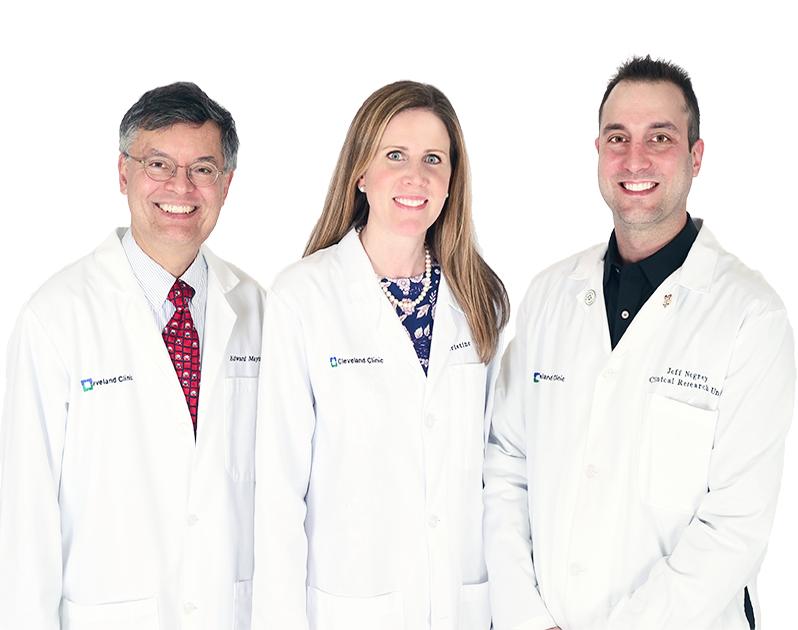
At the Cleveland Clinic site (left to right): Edward Maytin, MD PhD (Principal Investigator); Christine Warren, MD MPH (Co-investigator); Jeffrey Negrey (Study Coordinator)
What disease are we treating?
Basal cell carcinoma (BCC): BCC is the most common type of skin cancer. It typically occurs in individuals with a fair complexion and many years of chronic sun exposure. BCC is usually treated with surgery, which usually leaves a scar. Our clinical trial will test a non-scarring alternative to surgery.
Basal Cell Nevus Syndrome (Gorlin syndrome): This is a genetic (heritable) condition in which patients develop multiple BCC tumors, along with jaw cysts, palmar skin pits, and a number of other signs. The BCC tumors often start in childhood and continue accumulating over a lifetime, eventually numbering from a few dozen to many hundreds of tumors. For Gorlin patients, the need for multiple scarring surgeries can be debilitating and severely degrade their quality of life. Our clinical trial offers the potential to develop an effective, non-scarring alternative for these patients.
What treatment are we studying?
In this study, we are asking whether PDT shrinks tumors better when patients take Vitamin D supplements ahead of time.
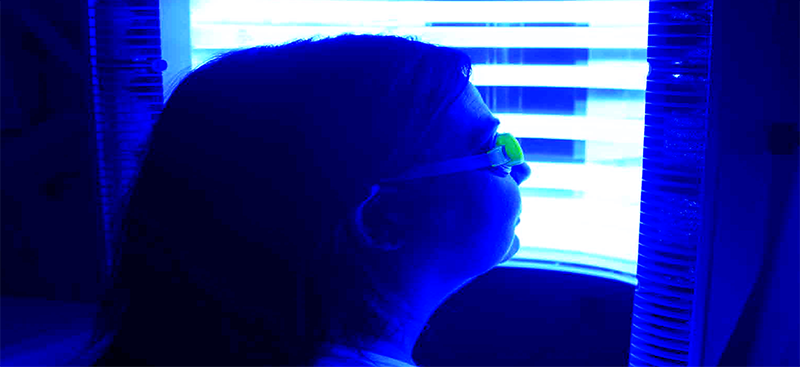
Photodynamic therapy (PDT): PDT is a treatment that involves two components: (1) a topical drug, called aminolevulinic acid, that accumulates preferentially in skin cancer cells and makes them photosensitive; (2) a strong visible light that is directed onto the tumor to activate the drug and destroy the cancer. Because blue light is the best wavelength for many PDT applications, we typically refer to PDT as “blue light therapy”.
The advantage of PDT is that it is noninvasive and can shrink or eliminate tumors without leaving any marks. Therefore, PDT is a scar-free option to surgery. The disadvantage is that for very thick tumors, the drug and the light cannot penetrate and PDT will not be very effective. What we found in our basic research work (studies in mice) prior to this clinical trial is that Vitamin D can improve the efficiency of PDT and help it work better. Our clinical trial is designed to test this idea in patients with basal cell carcinoma (BCC). If the combination of Vitamin D and PDT is shown to work well, then this combination may eventually become a safe and effective treatment option available to BCC patients.

Nathalie Zeitouni MD (Co-Investigator) and Dr. Maytin during a visit

What is involved in the clinical study?
- Three PDT treatments (spaced 2 months apart), plus an initial visit and final visit.
- Patients will receive Vitamin D or placebo pills prior to each PDT treatment.
- Photographs and lab work (blood test), and at least one skin biopsy will be taken during the study.
- Reimbursement for travel expenses, up to $200 per clinic visit.

Review Participant Consent Form